Fly Bottle presents
You live in society.
Learn to see how it works.
Sociology Mastery teaches college-level Introduction to Sociology — the sociological imagination, research methods, culture, stratification, institutions, and social change — in ten units built on the openly licensed OpenStax textbook and cross-checked against the standard college texts, drilled in with spaced repetition until the ideas are yours.
Free for 7 days · Cancel anytime
The gap
Sociology is one of the most-taken courses in college — and one of the easiest to leave behind after the final. Names and theories blur together: Durkheim, Weber, Merton, Du Bois. This course fixes that. It teaches the discipline the way the textbooks build it — perspective first, then methods, then the great structures of culture, inequality, and institutions — and uses active recall and spaced repetition to make the ideas durable, whether you are preparing for a midterm, the CLEP Introductory Sociology exam, or just a sharper eye for the news.
The method
Learn from the textbooks
Each unit is built on OpenStax Introduction to Sociology 3e — a full college textbook, free and openly licensed — and cross-checked against Macionis, Henslin, and Giddens et al. You study the real discipline; we make sure it sticks.
Active recall, not re-reading
Every concept is quizzed before it's shown. Flashcards and multiple-choice questions force retrieval — the effort that actually builds durable memory — including "predict what happens if…" questions that test understanding, not memorization.
Spaced repetition
A scheduler brings each card back at the edge of forgetting. Grade yourself honestly and its interval stretches from a day to a week to a month — or snaps back the moment you miss. A card counts as mastered only after correct recalls on separate days with its interval past a week.
Misconceptions, hunted
The course names the confusions directly — folkway vs. more, role conflict vs. role strain, prejudice vs. discrimination, correlation vs. causation — and tests you on telling them apart in realistic scenarios, the way college exams do.
The curriculum
Ten units, in the order the textbooks teach them — perspective and methods first, then culture, the self, groups, deviance, inequality, institutions, and change. 160 study cards in all, with the source chapters linked from every unit.
Built on the textbooks
This course stands on the standard college textbooks. The card bank is written from them and cross-checked across them; every unit links its chapters so you can go deeper. The topic outline of the College Board's CLEP Introductory Sociology exam — the credit-by-exam version of this course — is the exam cross-check.
OpenStax — Introduction to Sociology 3e
The backbone: a peer-reviewed college textbook from Rice University, published under a Creative Commons Attribution license (CC BY 4.0) and free to read online. All 21 chapters map onto this course's ten units.
Macionis — Sociology
John Macionis's Sociology (18th edition, Pearson) — among the most widely used texts in American intro courses, with its three-lens approach (structural-functional, social-conflict, symbolic-interaction) applied chapter by chapter.
Cross-check for structure, emphasis, and canonical examples.
Henslin — A Down-to-Earth Approach
James Henslin's Sociology: A Down-to-Earth Approach (Pearson) — the field's most readable text, known for grounding theory in everyday life and for its treatment of research methods and deviance.
Cross-check for clarity and for classic studies in context.
Giddens et al. — Introduction to Sociology
Anthony Giddens, Mitchell Duneier, Richard Appelbaum & Deborah Carr, Introduction to Sociology (Seagull 13th edition, Norton) — the global, research-forward text, strong on globalization, networks, and contemporary studies.
Cross-check for global coverage and current research.
See it
Diagrams drawn for this course, plus public-domain portraits of two founders — visual anchors for the ideas.
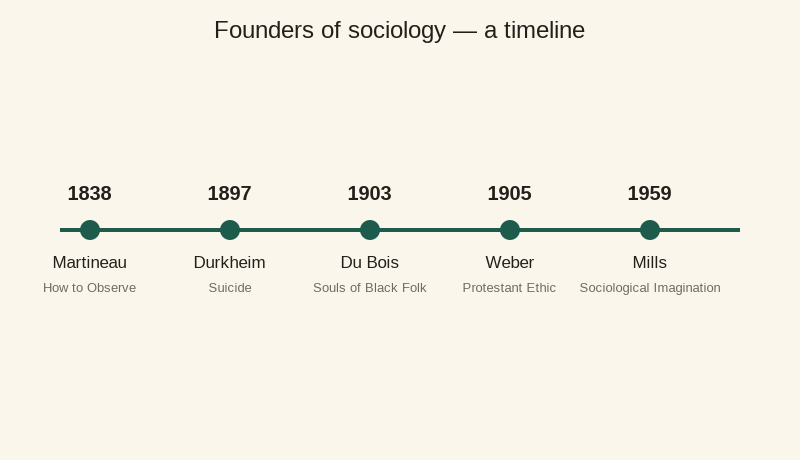
The founders
From Martineau's 1838 methods book to Mills's 1959 manifesto — the century that built the discipline. (Original diagram, Fly Bottle, CC BY 4.0.)

Émile Durkheim (1858–1917)
Social facts, solidarity, and Suicide (1897). Photograph before 1918, unknown author — public domain, via Wikimedia Commons.

W. E. B. Du Bois (1868–1963)
Double consciousness and The Philadelphia Negro (1899). Photograph by C. M. Battey, 1918, Library of Congress — public domain, via Wikimedia Commons.
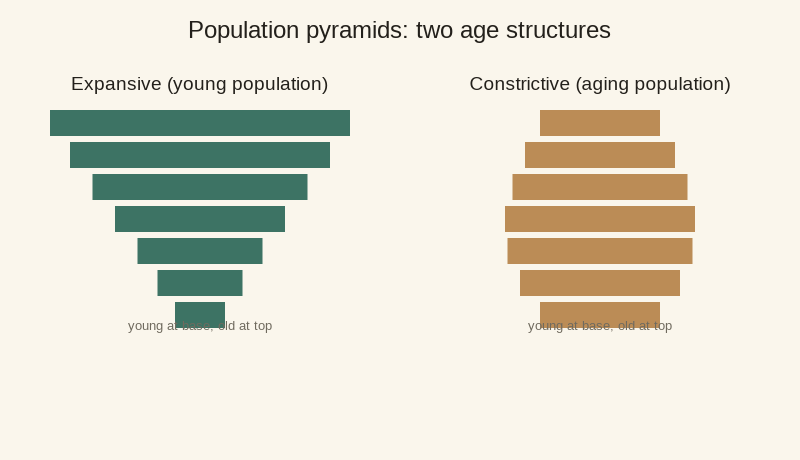
Population pyramids
A young, fast-growing population vs. an aging one — the demographic shapes behind Unit 10. (Original diagram, Fly Bottle, CC BY 4.0.)
The ladder
Study minutes move you up the ladder — from first observations to the title the discipline itself bestows.
Full access from day one — all ten units, every card, the daily check, and your state's leaderboard. After the trial, one simple subscription keeps it going. Cancel anytime.
- 10 units, 160 cards — perspective to social change
- Built on OpenStax, cross-checked against Macionis, Henslin & Giddens
- Spaced repetition with a daily check-in quiz
- Progress syncs across your devices
Create your account
Free for 7 days. You'll start at Unit 1 — the curriculum is a staircase, and every step is load-bearing.
Already have an account? Log in
Billing runs through Stripe. Your first Daily Check will be waiting on your first login.
Questions
Is this the college course — or CLEP prep?
Both. The content is undergraduate Introduction to Sociology, built on college textbooks. The topic outline of the CLEP Introductory Sociology exam (College Board's credit-by-exam program) is the cross-check, so the course doubles as CLEP preparation. Note: there is no "AP Sociology" — the College Board offers sociology credit through CLEP, not AP.
How much time does it take?
Ten units, designed for 10–20 minutes a day. Read the linked textbook chapters at your pace; the cards keep everything you\'ve covered fresh in a few minutes a day.
Is this affiliated with the textbook publishers or the College Board?
No. The course is built on OpenStax's openly licensed textbook (CC BY 4.0) and references the other texts and the CLEP outline, which remain their publishers' work. Fly Bottle's part is the curriculum path and the memory system around them.
What happens after the trial?
$12/month plus tax, billed through Stripe, renewing monthly until you cancel. Cancel in two clicks from Settings; access continues to the end of the paid period.
Society, explained — and remembered.
Seven days free. Ten units. The imagination, the methods, the structures.
Start free — 7 days →Free for 7 days · Cancel anytime
One step left
Your account is ready. Start your subscription to unlock all ten units — free for 7 days. Cancel anytime.
Have a free-access code?
Billing runs through Stripe. Manage or cancel your subscription any time from the billing portal — access continues to the end of the paid period.
Mastered = recalled correctly on at least two different days with a review interval of a week or more. Units unlock in order — master most of a unit to open the next.
Due reviews first, then new cards from your current unit. Sessions mix units you've opened on purpose: interleaving feels harder and works better.
Your units
Daily Check
Five questions from what's due — about two minutes. Answers count toward your cards' schedules, and finishing protects your streak.
How many minutes do you have today?
Study Session
Due reviews always come first. New cards come from your current unit, with reviews from every unit you've opened mixed in.
Session complete
Browse the card bank
Your state
Ranked by minutes studied this week (Monday–Sunday). Study time is logged automatically every time you finish a session or your Daily Check.
Settings
Your profile
Your display name and state power your state leaderboard. Other learners see your display name only — never your email address. Leave the state blank to stay off leaderboards.
Account & billing
Signed in as — · Subscription: —
Have a free-access code?
Your progress
Progress is saved to your account and synced across devices; this browser keeps a local cache so the app still opens offline. Export a copy any time.
Help & FAQ
How do units unlock? Master at least 60% of a unit's cards — recalled correctly on two different days, with review intervals past a week — and the next unit opens. Reviews from open units keep appearing in every session.
What counts as study time? Time inside sessions and Daily Checks, measured while you're answering. It drives your streak, your weekly minutes, and your ladder level (Novice → Sociologist).
The textbook is free — why pay? OpenStax stays free, on its own site. What you pay for is the path through it and the memory system: sequencing, 160 cards written against the material, spaced repetition, and tracking that makes the knowledge stick.
Stuck or something looks wrong? Email support@flybottle.ai — a human reads it.
How the scheduling works
Each card carries its own memory model: an ease factor and an interval. Grade yourself honestly — Again brings the card back soon and shrinks its interval; Hard grows it slowly; Good follows the standard ladder (1 day → 3 days → then multiplied by your ease factor); Easy stretches it further. A card is mastered when you've recalled it successfully on at least two different days with its interval at a week or more — the same retrieval-practice and spacing principles the memory research behind this app is built on.